Santa Cruz de la Sierra
Bolivia's largest city and primary economic hub.
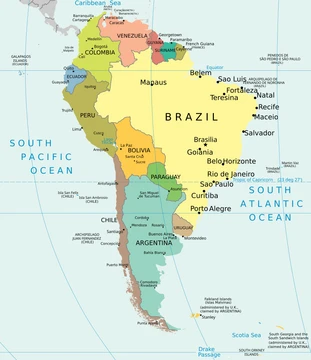
Santa Cruz de la Sierra, often shortened to Santa Cruz, is Bolivia’s biggest city and serves as the capital of the Santa Cruz department. The metropolitan area, which sits along the Pirai River in the country’s eastern tropical lowlands, forms the most populous urban cluster in Bolivia; by 2020, it held an estimated 2.4 million people. This conurbation includes seven municipalities: Santa Cruz de la Sierra itself, La Guardia, Warnes, Cotoca, El Torno, Porongo, and Montero.
The city was first established in 1561 by Spanish explorer Ñuflo de Chavez, roughly 200 kilometers east of where it stands today. It was relocated several times before finally settling on the Pirai River in the late 1500s. For most of its history, Santa Cruz remained a small outpost. Even after Bolivia gained independence in 1825, the region drew little interest from authorities or settlers. Only after the mid-20th century, following major agrarian and land reforms, did the city begin to expand rapidly. Because of its low elevation at the foothills of the Andes and its location in the Amazon basin, Santa Cruz has a tropical climate—a sharp contrast to the other major metro area, La Paz, which sits thousands of meters higher.
Santa Cruz is Bolivia’s most populous city, generates nearly 35% of the country’s gross domestic product, and attracts over 40% of all foreign direct investment. It stands as the nation’s primary business hub and the top destination for both domestic and international migrants.
**History**
**Pre-Columbian era**
The history of the area before European contact is poorly recorded, largely because local tribes were nomadic and lacked a written language. Recent evidence, however, suggests that the current site of Santa Cruz was inhabited by an Arawak group later known to the Spanish as the Chané. Ceramics and weapons found in the region indicate they had established settlements there. According to accounts from early Spanish explorers, the Chané had a formal leader, a cacique named Grigotá, who ruled for several years until his reign ended during one of the Guarani (Chiriguano) incursions into the area.
**Early European incursions and founding of the city**
The first Europeans to reach the area were Spanish conquistadors from the newly created Governorate of New Andalusia, which covered parts of present-day Argentina, Uruguay, Paraguay, and Chile. In 1549, Captain Ge
- founded
- 1561 by Ñuflo de Chavez
- location
- Pirai River, eastern Tropical Lowlands of Bolivia
- population_2020
- 2.4 million (metropolitan region)
- elevation
- approximately 400 m above sea level
- climate
- tropical
- economic_share
- nearly 35% of Bolivia's GDP
- foreign_direct_investment
- over 40% of all foreign direct investment in Bolivia
Lore & Background
The city was first founded in 1561 by Spanish explorer Ñuflo de Chavez about 200 km east of its current location. It was moved several times, finally established on the Pirai River in the late 16th century. For much of its history, Santa Cruz was a small outpost town; even after Bolivia's independence in 1825, the region received little attention. Growth accelerated after the mid-20th century following agrarian and land reforms.
Before European arrival, the area was inhabited by an Arawak tribe known to the Spanish as Chané. The first European to explore the region was Captain General Domingo Martinez de Irala in 1549. Ñuflo de Chavez led an expedition in 1558 and founded the city on February 26, 1561, naming it after his hometown in Extremadura. After Chavez's death in 1568, conflicts and power struggles led to relocations; the city was moved to the Guapay Empero river in 1590 and again in 1595, finally consolidating under its original name in 1622.
During the colonial period, the city served as a staging point for Jesuit missions and helped contain Portuguese Bandeirantes. In 1810, local revolutionaries overthrew the governor delegate. After a period of imperial control, revolutionary forces led by Ignacio Warnes liberated the city in 1813. Following Warnes's defeat in 1815, continued uprisings deposed the last Spanish governor in February 1825.
Reader's Guide
Santa Cruz de la Sierra is Bolivia's most populous city and its most important business center, producing nearly 35% of the nation's GDP and receiving over 40% of all foreign direct investment. Its metropolitan region, formed by seven municipalities, is the country's principal destination for national and international migrants. The city's tropical climate, due to its low elevation in the Amazon basin, contrasts with the high-altitude climate of La Paz. Historically a small outpost, Santa Cruz grew rapidly after mid-20th-century agrarian reforms, transforming into Bolivia's economic powerhouse. Its founding by Ñuflo de Chavez in 1561 and subsequent relocations reflect the challenges of colonial settlement in the region. The city played a role in the Spanish Empire's border consolidation and later in the revolutionary wars for independence. Today, Santa Cruz remains central to Bolivia's economy and demography.
Did You Know?
- The city was first founded in 1561 about 200 km east of its current location.
- Santa Cruz produces nearly 35% of Bolivia's gross domestic product.
- The metropolitan region had an estimated population of 2.4 million in 2020.
- The city was originally named after Ñuflo de Chavez's hometown in Extremadura.
More in South American Cities 1-24
Elsewhere in the South American Cities universe
Spotted an error? Know more?
This is a living reference — every entry is fact-audited, and reader corrections feed straight into our audit queue. Suggest an edit · See this site's audit record