Sucre
De jure capital of Bolivia and UNESCO World Heritage Site.
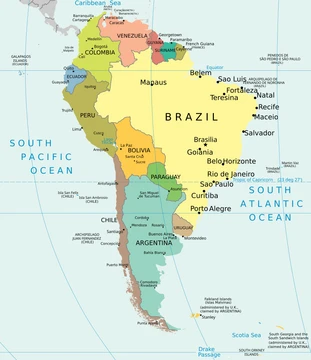
Sucre, officially La Ilustre y Heroica Sucre, is the de jure capital city of Bolivia, the capital of the Chuquisaca Department, and the sixth most populous city in the country. It holds major national importance as an educational and government center, as well as the location of the Bolivian Supreme Court. Its historic city centre is one of the best preserved Hispanic colonial and republican centers in the Western Hemisphere, leading to its designation as a UNESCO World Heritage Site.
- Original Name
- Ciudad de la Plata de la Nueva Toledo (also known simply as La Plata)
Lore & Background
Prior to Spanish colonization, the area was home to an indigenous settlement known as Chuqichaka, though it was not a major Inca provincial capital as sometimes claimed. The Spanish later called the region Chuquisaca. The name Chuqichaka possibly derives from Quechua words meaning 'a heap of precious metal' or 'a pile of silver'. After the Inca ruler Topa Inka Yupanqui conquered the original Aymara kingdom, the Quechua language was imposed. The Charcas people, known as warriors, were recruited in large numbers by Wayna Qhapaq for northern campaigns. During those wars, the Guarani-speaking Chiriguanos invaded the Charcas frontier, and the Portuguese conquistador Aleixo Garcia is believed to be the first European to make contact with Charcas in 1525.
Reader's Guide
Sucre's significance stems from its role as the first capital of Bolivia and its enduring status as the constitutional capital, despite the transfer of the seat of government to La Paz in 1898. The city was a major center during the colonial era as the seat of the Real Audiencia de Charcas, with authority over a vast region including parts of modern Paraguay, Peru, Chile, Argentina, and Bolivia. Its temperate climate attracted Spanish royalty and wealthy families involved in the silver trade from Potosí. The Bolivian independence movement began here on May 25, 1809, with the ringing of the bell of the Basilica of Saint Francisco. Today, Sucre remains the seat of the judiciary and the Roman Catholic Church in Bolivia, and its well-preserved colonial architecture continues to draw visitors and scholars.
Did You Know?
- Sucre is one of the highest capital cities in the world at an elevation of 2,810 m (9,220 ft), though it is lower than both La Paz (3,640 m) and Quito (2,850 m).
- The city was originally founded as Ciudad de la Plata de la Nueva Toledo (or simply La Plata) on November 30, 1538.
- The Bolivian independence movement began in Sucre on May 25, 1809, with the ringing of the bell of the Basilica of San Francisco (often linked to the 'First Cry of Freedom' in Chuquisaca).
- Sucre's St Francis Xavier University, founded in 1624, is one of the oldest universities in the New World.
Frequently Asked Questions
What is Sucre and why does it hold two capital titles in Bolivia?
Sucre (officially La Ilustre y Heroica Sucre) is the de jure capital of Bolivia and the seat of the Chuquisaca Department. It houses the nation's Supreme Court and serves as a major governmental and educational hub, even though La Paz handles much of the day-to-day executive work.
Why is Sucre a UNESCO World Heritage Site?
Its historic city centre is widely regarded as one of the best-preserved examples of Hispanic colonial and republican architecture in the entire Western Hemisphere. That exceptional preservation of both eras earned it the UNESCO designation.
When was Sucre founded and what was it originally called?
The city was established on November 30, 1538, under the name Ciudad de la Plata de la Nueva Toledo. It has since been renamed in honor of the independence-era figure Antonio José de Sucre.
What is it like to live in Sucre in terms of elevation and climate?
Sucre sits at roughly 2,790 meters (about 9,150 feet) above sea level, giving it a cool subtropical highland climate classified as Cwb under the Köppen system. Residents experience mild, dry winters and warm, wet summers typical of the Andean altiplano fringe.
How big is Sucre compared to other Bolivian cities?
It ranks as the sixth most populous city in Bolivia, making it a mid-sized urban center. Despite not being the largest, its constitutional and judicial functions give it outsized national importance.
More in South American Cities 25-31
Elsewhere in the South American Cities universe
Spotted an error? Know more?
This is a living reference — every entry is fact-audited, and reader corrections feed straight into our audit queue. Suggest an edit · See this site's audit record