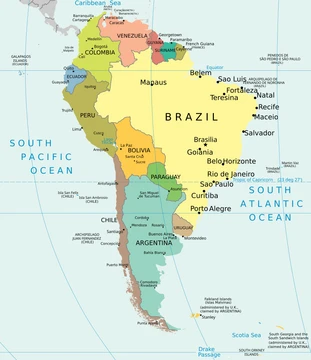
Curitiba
Capital of Paraná, known for pioneering urban planning.
Curitiba is the capital and largest city of the state of Paraná in Southern Brazil. It is known for its innovative urban planning, which began in the 1960s and transformed the city from a few hundred thousand inhabitants to over a million, and for its high quality of life, including a very high Human Development Index and recognition as a Global Sustainable City.
- country
- Brazil
- state
- Paraná
- population_2024
- 1,829,225
- metropolitan_population
- over 3,559,366
- elevation
- 932 m (3,058 ft) above sea level
- founded
- 1693 (as Vila da Nossa Senhora da Luz dos Pinhais)
- known_for
- Innovative urban planning, sustainable development, host of 1950 and 2014 FIFA World Cups
Lore & Background
Curitiba sits on a plateau at 932 meters above sea level, west of the seaport of Paranaguá. Its name likely derives from Tupi words meaning 'many araucária seeds' or 'pine tree large amount,' reflecting the region's original Paraná pines. The Portuguese founded a settlement there in 1693, naming it Vila da Nossa Senhora da Luz dos Pinhais; the name was changed to Curitiba in 1721. It became a town in 1812, with spelling variations including Curityba and Coritiba, settled by a 1919 decree adopting Curitiba.
In the 19th century, Curitiba's location between cattle-breeding countryside and marketplaces spurred a successful cattle trade and its first major expansion. Between 1850 and 1950, logging and agricultural expansion—first Araucaria angustifolia logging, then mate and coffee cultivation, and later wheat, corn, and soybean—drove growth. Waves of European immigrants, mainly Germans, Italians, Poles, and Ukrainians, arrived after 1850, contributing to economic and cultural development. Today, only small numbers of immigrants arrive, primarily from Middle Eastern and other South American countries.
Curitiba's biggest expansion occurred after the 1960s, driven by a master plan developed by a group of young planners and architects led by Jaime Lerner from the Federal University of Paraná. This plan improved upon an earlier, expensive plan by Alfred Agache, adding major linear transit pathways, reducing downtown traffic, minimizing urban sprawl, providing accessible public transit, and preserving the historic district. The city's economy, based on industry and services, is the seventh largest in Brazil, and approximately half of its population was not born in Curitiba.
Reader's Guide
Curitiba's significance lies in its pioneering urban planning, which transformed it into a model of sustainable development. The city's master plan, adopted in the 1960s, emphasized high-speed transit corridors, downtown traffic reduction, and preservation of historic areas, allowing the population to grow from hundreds of thousands to over a million. This planning earned Curitiba the 2010 Global Sustainable City Award and recognition as the best 'Brazilian Big City' to live in by Reader's Digest. Its economy, the seventh largest in Brazil, is based on industry and services, with a low unemployment rate of 4.3% in 2025. Curitiba also hosted the 1950 and 2014 FIFA World Cups. The city's crime rate is considered low by Brazilian standards, and it is regarded as one of the safest cities in Brazil for youth and the best for investment. Its cultural and economic role is enhanced by the Federal University of Paraná, established in 1912, and its diverse immigrant heritage. The legacy of Curitiba's intentional urban design continues to influence city planning globally.
Did You Know?
- Curitiba's name may come from Tupi words meaning 'many araucária seeds' or 'pine tree large amount.'
- The city was originally named Vila da Nossa Senhora da Luz dos Pinhais when founded in 1693.
- Curitiba's master plan was developed by a group of young planners and architects led by Jaime Lerner from the Federal University of Paraná.
- The city was one of the host cities for both the 1950 and 2014 FIFA World Cups.
More in South American Cities 1-24
Spotted an error? Know more?
This is a living reference — every entry is fact-audited, and reader corrections feed straight into our audit queue. Suggest an edit · See this site's audit record