Bahía Blanca
Argentine port city founded as a fortress in 1828.

Wikipedia / Wikimedia Commons
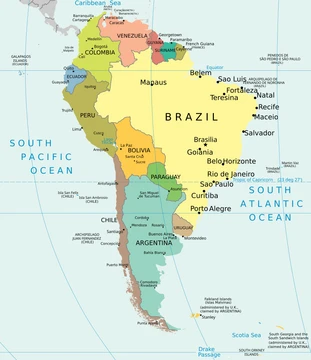
Bahía Blanca (pronounced [baˈi.a ˈβlaŋka], meaning "White Bay"), often called simply Bahía by locals, is a city in Argentina’s Buenos Aires province. It sits at the northwestern end of the Blanca Bay, an estuary on the Argentine Sea. It ranks as the fifth-largest city in the province and the sixteenth-largest in the country by metropolitan population. The city serves as the seat of government for the Bahía Blanca Partido, with 336,574 residents as of the 2022 census (INDEC), and is the core of the Greater Bahía Blanca metropolitan area. Its seaport is a key asset, with a consistent depth of 15 meters (49 feet) along most of the bay, where the Napostá Stream empties. The name "White Bay" comes from the salt that whitens the local soil along the shores. Ferdinand Magellan sighted the bay in 1520 during the expedition that would complete the first circumnavigation of the world, commissioned by Charles I of Spain, while searching for a passage between the Atlantic and Pacific along South America’s coast.
The city was founded as a fortress on April 11, 1828, by Colonel Ramón Estomba under orders from Brigadier-General Juan Manuel de Rosas, who was already serving as governor of Buenos Aires at the time. Originally called Fortaleza Protectora Argentina, it was built to shield settlers from cattle rustlers and to guard the coast against potential threats. Charles Darwin visited in September 1833 during his South American travels. The fortress faced several attacks by Malones—mounted incursions by nomadic indigenous groups—including a notable assault in 1859 by 3,000 warriors led by Calfucurá. Its commercial importance grew after the Buenos Aires Great Southern Railway connected the town to Buenos Aires in 1884, with regular service beginning in 1885, enabling grain transport from the Pampas.
Rapid economic growth, European immigration policies, and Argentina’s natural resources drew many newcomers, mainly from Spain and Italy, along with a notable French community that settled in Pigüé, about 125 kilometers north. Another significant settlement was of Dutch immigrants in Tres Arroyos, roughly 250 kilometers northeast. Large groups of Germans and Eastern European Jews also arrived in the city and region in the early 20th century, as well as during and after World War II. These immigrants brought their customs, leading to at least five opera h
- Founded
- 11 April 1828
- Founder
- Colonel Ramón Estomba
- Country
- Argentina
- Province
- Buenos Aires
- Population (2022 census)
- 336,574
- Known for
- Major seaport and commercial center; site of Argentina's largest naval base (Puerto Belgrano)
Lore & Background
The city was founded as a fortress on 11 April 1828 by Colonel Ramón Estomba on the orders of Brigadier-General Juan Manuel de Rosas, who was already serving as Governor of Buenos Aires. It was initially named Fortaleza Protectora Argentina (Argentine Protective Fortress), built for the purpose of protecting inhabitants from cattle rustlers and guarding the coast. It was visited by Charles Darwin during his travels through South America in September 1833. The fortress was attacked by Malones (incursions of nomadic aboriginals on horseback) several times, most notably in 1859 by 3,000 Calfucurá warriors. It became commercially important after the Buenos Aires Great Southern Railway linked the town to the city of Buenos Aires in 1884.
Reader's Guide
Bahía Blanca is significant as a major Argentine port and commercial hub, handling large exports of grains, wool, oil, and fruit. Its group of seaports is among the most important in the country, being naturally deep and maintained at 12.19 m (40 ft). The city's economy is bolstered by a petrochemical pole, including one of the world's largest urea producers, Profertil. The combination of a railroad network linking Rosario to Bahía Blanca, energy availability, and human resources makes the area industrially and commercially attractive. The city also hosts Argentina's largest naval base, Puerto Belgrano, built between 1898 and 1902. Culturally, European immigration in the late 19th and early 20th centuries brought opera houses and cinemas. The March 2025 flood, the most devastating in Argentina since 1975, highlighted the city's vulnerability to extreme weather and prompted national and international solidarity. The municipal government includes a mayor, city council, and local judiciary; a political crisis in 2006 led to the first unseating of an elected mayor in the city's history.
Did You Know?
- The name Bahía Blanca means 'White Bay,' due to the color of salt covering the local soil.
- The bay was seen by Ferdinand Magellan in 1520 during his first circumnavigation of the world.
- Charles Darwin visited the fortress in September 1833 during his travels through South America.
- Puerto Belgrano, Argentina's largest naval base, was designed by Italian engineer Luigi Luiggi and built from 1898 to 1902.
Frequently Asked Questions
Who is Bahía Blanca?
Bahía Blanca is a coastal city in Argentina's Buenos Aires province, perched at the northwestern tip of the Blanca Bay estuary where it meets the Argentine Sea. In casual local speech, residents usually drop the second half and simply call it 'Bahía'.
What is Bahía Blanca's role in the wider story?
The city operates as a major commercial and seaport hub while also anchoring Puerto Belgrano, the largest naval installation in Argentina. It doubles as the administrative seat of the Bahía Blanca Partido, giving it both economic and governmental weight.
How does Bahía Blanca's origin story go?
Colonel Ramón Estomba laid the groundwork on 11 April 1828, originally establishing the site as a fortified outpost. From that small military garrison it steadily expanded into the fourth-largest city in Buenos Aires province.
Why is Bahía Blanca important to the South American cities lineup?
With 336,574 inhabitants recorded in the 2022 INDEC census, it stands as the sixteenth-largest metropolitan area in the country. Its consistently deep seaport makes it a pivotal trade gateway along the Argentine coastline.
Where does Bahía Blanca sit geographically?
The city occupies the northwestern end of the Blanca Bay estuary, which funnels out into the open Argentine Sea. It forms the core of the Greater Bahía Blanca metropolitan area in the southern reaches of Buenos Aires province.
More in South American Cities 1-24
Elsewhere in the South American Cities universe
Spotted an error? Know more?
This is a living reference — every entry is fact-audited, and reader corrections feed straight into our audit queue. Suggest an edit · See this site's audit record