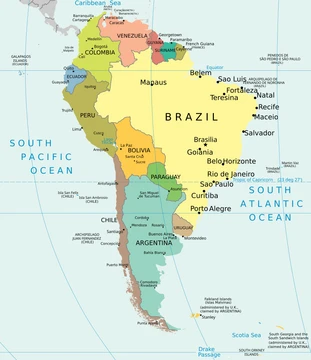
Antofagasta
Port city in northern Chile, captured in 1879, triggering the War of the Pacific.

Wikipedia / Wikimedia Commons
Antofagasta is a port city in northern Chile, about 1,100 kilometers north of Santiago. It is the capital of Antofagasta Province and Antofagasta Region, and as of the 2017 census, with a population of 361,873, it is the fourth-largest city in Chile. Once claimed by Bolivia following the Spanish American wars of independence, Antofagasta was captured by Chile on 14 February 1879, triggering the War of the Pacific, and Chilean sovereignty was officially recognized by Bolivia under the 1904 Treaty of Peace and Friendship.
- Population (2017 census)
- 361,873
- Elevation
- 0–10 m (0–33 ft)
- Area
- 30,718 km² (commune total)
Lore & Background
The territory of Antofagasta was part of the Viceroyalty of the Río de la Plata and later Bolivia until the Boundary Treaty of 1866. The area was disputed between Chile and Bolivia until that treaty, which established a demarcation line between Chile and Bolivia without transferring sovereignty. On 18 September 1866, José Santos Ossa and Francisco Puelma achieved the award of the concession of nitrate lands, leading to the formation of the Sociedad Exploradora del Desierto de Atacama. On 8 May 1872, Antofagasta was designated by the Bolivian Government as Puerto Mayor, opening trade worldwide. In 1873, the Compañía de Salitres y Ferrocarril de Antofagasta, a Chilean mining company, signed a contract with the government of Bolivia removing taxes for 15 years, but this contract was not ratified by the Bolivian Congress.
Reader's Guide
Antofagasta's significance stems from its role as a port and service hub for one of Chile's major mining areas. Historically important for silver and saltpeter mining, since the mid-19th century copper mining has been the most important activity, fueling growth in construction, retail, and population until the end of the 2000s commodities boom in 2013. Since the 2010s, it has also become a service hub for lithium mining. The city's capture by Chile on 14 February 1879 triggered the War of the Pacific, and its sovereignty was formalized by the 1904 Treaty of Peace and Friendship. Antofagasta is the seat of one of Chile's three environmental courts and is a university city, home to the Catholic University of the North and the University of Antofagasta. In 2012, it had the highest GDP per capita in Chile at US$37,000 and ranked third in the Human Development Index. The city's climate is a cold desert climate (Köppen BWk) with extreme aridity, receiving less than 0.1 mm of rainfall annually, making it the world's driest town. However, sporadic heavy rainfall has caused mudslides, notably in 1991, which devastated much of the city.
Did You Know?
- Antofagasta was captured by Chile on 14 February 1879, triggering the War of the Pacific.
- The city receives only about 1–2 mm of rainfall per year, making it one of the driest cities in the world, though the title of driest non-polar town is usually given to Arica or Iquique, Chile.
- In 2012, Antofagasta had the highest GDP per capita in Chile, at US$37,000.
- The name Antofagasta is 'presumably' derived from Antofagasta de la Sierra in Catamarca Province, Argentina.
Frequently Asked Questions
Who is Antofagasta?
Antofagasta is a port city located in northern Chile, roughly 1,100 kilometers north of Santiago. It serves as the capital of both Antofagasta Province and the broader Antofagasta Region, and its 2024 census population of 401,096 makes it the fifth-largest city in the country.
What is Antofagasta's role in Chile?
As a major port on the Pacific coast, Antofagasta functions as a key gateway for trade and resource extraction in the Atacama desert region. Its GDP per capita of around US$37,000 (2012) reflects the economic weight the mining and shipping industries carry for the city.
How does Antofagasta's origin story begin?
The city was originally claimed by Bolivia after the Spanish American wars of independence, sitting in what was then Bolivian territory. That status changed on 14 February 1879, when Chilean forces seized the city, an event that immediately ignited the War of the Pacific.
How does Antofagasta's conflict storyline resolve?
The decades-long dispute between Chile and Bolivia over the city was formally settled by the 1904 Treaty of Peace and Friendship. Under that agreement, Bolivia recognized Chilean sovereignty over Antofagasta, bringing the territorial question to a close.
Why is Antofagasta important to South American history?
The city's capture in 1879 is widely cited as the direct trigger for the War of the Pacific, one of the most consequential conflicts in the region's 19th-century history. Its strategic position as a northern Chilean port on the Pacific made it a prize both nations fought over for decades.
More in South American Cities 1-24
Elsewhere in the South American Cities universe
Spotted an error? Know more?
This is a living reference — every entry is fact-audited, and reader corrections feed straight into our audit queue. Suggest an edit · See this site's audit record