Arica
Chile's northernmost port city and free port for Bolivia.

Wikipedia / Wikimedia Commons
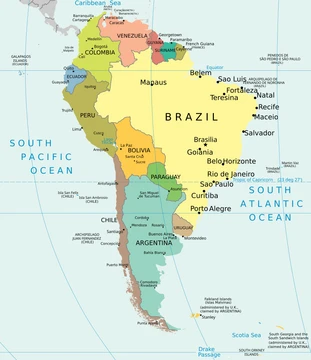
Arica is a port city and commune in northern Chile, serving as the capital of both the Arica Province and the Arica y Parinacota Region. It is Chile's northernmost city, located 18 km south of the border with Peru, at the bend of South America's western coast known as the Arica Bend. The city has been an important port since Spanish colonial rule and currently functions as a free port for Bolivia, handling a substantial part of that country's trade. Arica is also notable for its extremely dry climate, mild weather, and its role as the site of the 1970 training led by spiritual master Oscar Ichazo that gave rise to the Arica School.
- annexed_by_chile
- 1883 (ceded by Peru via Treaty of Ancón; permanent cession confirmed in 1929)
Lore & Background
Arica has been inhabited by native groups for 10,000 years, including the Chinchorro culture, who are the first known culture to mummify their dead, predating the Egyptians by 2,000 years. Spaniards settled the area in 1541 under captain Lucas Martinez de Begazo, and by 1545 Arica became the main export entrepot for Bolivian silver from Potosí, making it a leading port of the Spanish Empire and a target for pirates such as Francis Drake and Thomas Cavendish. The city was hit by a destructive earthquake and tsunami in November 1604, causing it to be rebuilt.
Following the collapse of Spanish rule, Arica became part of Peru in 1821. In 1855, Peru inaugurated the Tacna–Arica railway, one of the first in Latin America. The earthquake of August 13, 1868 struck near the city with an estimated magnitude of 8.0 to 9.0, triggering a tsunami measurable across the Pacific. Chilean forces occupied the region during the War of the Pacific, and the Treaty of Ancón in 1883 formally ceded Tarapacá to Chile while stipulating a plebiscite for Tacna and Arica—a dispute not resolved until the 1929 Treaty of Lima, which permanently awarded Arica to Chile and returned Tacna to Peru.
In 1958, the Chilean Government established the Board of Development for Arica, offering tax incentives that attracted car assembly plants from Citroën, Peugeot, Volvo, Ford, and General Motors. The Arica y Parinacota Region was created on October 8, 2007. In the 1980s, a toxic waste dumpsite from Swedish company Boliden Mineral AB led to severe health problems among local residents, including arsenic-related cancers and fertility issues.
Reader's Guide
Arica's significance lies in its strategic location as a port city at the bend of South America's western coast, serving as a free port for Bolivia and handling a substantial part of that country's trade. Its position next to the Pan-American Highway, rail connections to Tacna and La Paz, and international airport enhance its role as a trade hub. The city is also notable for its archaeological importance, with findings of the Chinchorro mummies dating back 10,000 years, the oldest known mummies in the world. In 1970, Arica gained international fame as the site of a 10-month training led by Oscar Ichazo for 50 North Americans from the Esalen Institute, which led to the founding of the Arica School, influencing thousands worldwide. The city's mild climate has earned it the nickname 'city of the eternal spring,' and its beaches are frequented by Bolivian society. Arica's history includes periods under Spanish colonial rule, Peruvian control, and Chilean annexation after the War of the Pacific. The toxic waste scandal involving Boliden and Promel has had lasting health impacts on the local population, with high rates of arsenic-related diseases documented.
Did You Know?
- Arica is located at the bend of South America's western coast known as the Arica Bend or Arica Elbow.
- The origin of the city's name is uncertain; it may come from the Aymara language or from the Inca chief Ariacca, but the Kunza term 'arisca' meaning 'new bay' is not widely confirmed.
- Archaeological findings indicate that the Chinchorro culture in Arica mummified their dead, predating the Egyptians by 2,000 years.
- In 1970, spiritual master Oscar Ichazo held a 10-month training in Arica for 50 North Americans from the Esalen Institute.
Frequently Asked Questions
Who is Arica?
Arica is Chile's northernmost city, a port commune that doubles as the capital of both the Arica Province and the Arica y Parinacota Region. It sits just 18 km south of the Peruvian border, right at the Arica Bend on South America's Pacific coast.
What is Arica's main role?
Arica operates as a free port through which a large share of Bolivia's international trade flows, giving the landlocked country its primary maritime access. The port has held strategic importance since Spanish colonists founded the settlement in 1541.
Where exactly is Arica located?
The city occupies the Arica Bend, the distinctive curve in South America's western coastline, in the far northern tip of Chile. It is the country's most northerly urban center, with Peru lying immediately to its north.
What is Arica famous for?
Beyond its trade function, Arica is recognized for the ancient Chinchorro mummies discovered in the surrounding area, the Arica School of spiritual and psychological training founded by Oscar Ichazo, and its status as Bolivia's key gateway to the sea.
What is Arica's climate like?
Arica enjoys an extremely dry, moderate desert climate with mild, stable temperatures throughout the year. It ranks among the driest inhabited places on the planet, receiving very little annual rainfall.
More in South American Cities 1-24
Elsewhere in the South American Cities universe
Spotted an error? Know more?
This is a living reference — every entry is fact-audited, and reader corrections feed straight into our audit queue. Suggest an edit · See this site's audit record