Frequently Asked Questions
The most-asked questions about south american cities.
What is this encyclopedia actually about?
It is a fan-created reference guide to South America's major urban centers, covering their founding stories, landmarks, cultural output, and the ways they relate to one another across the continent.
Who are the central figures that keep coming up?
Independence-era leaders like Simón Bolívar and José de San Martín shaped the political identity of most capitals, while cultural icons such as Jorge Luis Borges (Buenos Aires), Oscar Niemeyer (Brasília), and the literary orbit around Bogotá give the cities their creative signatures.
Where should a newcomer begin exploring?
Buenos Aires is the most commonly recommended starting point because its compact historic core, tango heritage, and layered European-Latin American identity make it an accessible gateway into the broader urban landscape.
How many cities does the continent actually have?
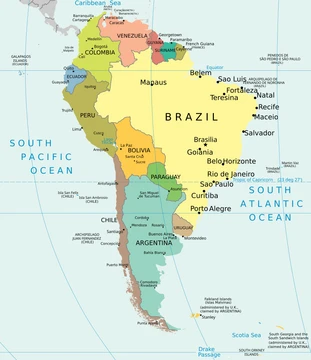
South America is home to well over fifty metropolitan areas with populations above one million, though the encyclopedia concentrates on roughly twenty to twenty-five of the most historically and culturally significant ones.
What are the key geographic facts a reader should know?
The continent's cities range from La Paz sitting at roughly 3,600 metres in the Andes, to Manaus deep in the Amazon basin, to Rio de Janeiro on the Atlantic coast, producing an extraordinary variety of urban climates and topographies.
What is the most striking origin story among them?
Brasília, Brazil, was conceived, designed, and largely built between 1956 and 1960 under the direction of architect Oscar Niemeyer and urbanist Lúcio Costa, making it one of the very few modern capitals raised from scratch in a single planned burst.
What themes recur across the cities?
A persistent tension between colonial-era grid planning and organic modern growth, the layering of indigenous heritage beneath European architecture, and the economic pull between coastal trade ports and inland agricultural heartlands appear again and again.
What is the single most iconic landmark in the whole set?
The Art Deco Christ the Redeemer statue crowning Corcovado hill in Rio de Janeiro, completed in 1931, is widely regarded as the most photographed and instantly recognizable urban monument on the continent.
How do the cities link to one another?
Shared Spanish and Portuguese linguistic roots, parallel independence movements in the early 1800s, and modern corridors like the BR-101 highway and Trans-Andean routes weave them into a coherent if diverse urban network.
What makes this urban universe distinct from any other region?
No other continent packs Andean highland capitals, Amazonian river cities, Patagonian windswept ports, and Caribbean coastal metropolises into one contiguous landmass, giving its cities a range of settings that is genuinely unmatched.